
G
La Garzette
Le journal le plus lu les pieds dans l'eau. Abonnez-vous !

At daybreak, two figures move away against the current, their canoe slaloming between the little islands dotted along this “river of sand”. Storms have been raging over the past few days, sometimes directly above us.
As they navigate the Loire, Barbara and Julien sample two invisible, albeit very different types of traces of life. One is common to all living things: environmental DNA, the analysis of which is breaking new ground in terms of biodiversity inventorying, in the Loire and elsewhere. The other comes solely from humans: microplastics. These tiny particles are now present in the air, the soil and the water cycle. Everywhere. They break down infinitely, colonise organisms and disrupt balances. Unlike pottery, used for thousands of years as containers, which disintegrates until it eventually dissolves, plastic never disappears. It encroaches even into our bodies, spawning the emergence of a new hybrid being.
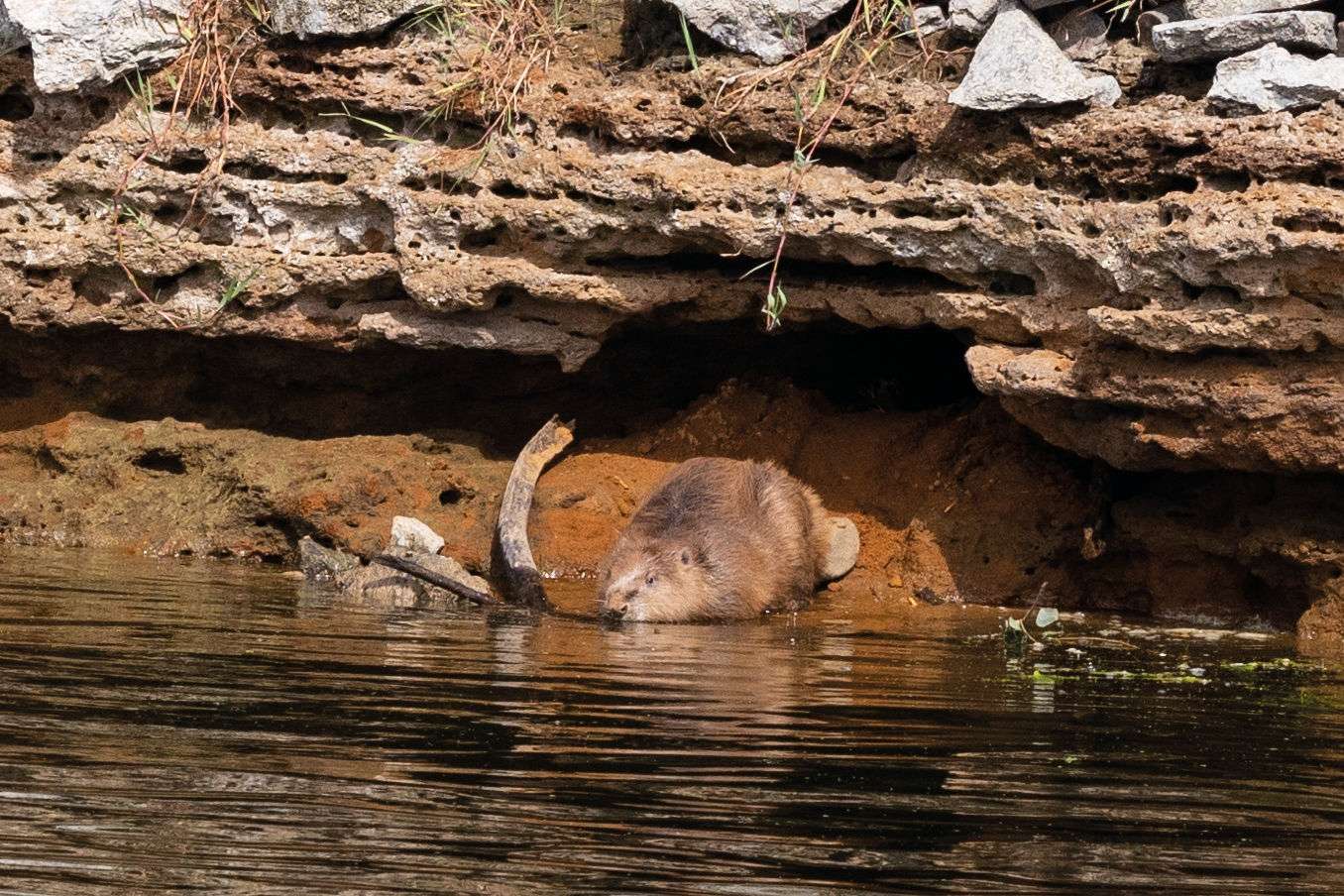
On our camping pitch, beavers were there before us. We pull in alongside a bank that they have already adapted - as their guests. The whole place is strewn with “logging sites”, “chutes”, droppings, prints and the musky smell of castoreum. Every year, the Loire refashions the islands here, weaving its way between the wooded sandbanks; the beavers’ tracks, fleeting and harmless, fade away as the water rises and falls and the geography, which they also shape, shifts and evolves. The next morning, we drift alongside a high sandy bank where colonies of swallows are nesting. These creatures, drawn to sheltered nooks and crannies, seem to organise their nests into small villages, a few dozen centimetres apart. Do they always return to the same nest as they come and go between Europe and Africa? How do these “village units” function?
Soon, on the left bank, Chinon’s nuclear power plant, a 150-hectare site, comes into view. Massive grey buildings loom up, immense cooling systems shaped like a stadium; and this giant concrete “ball”, France’s first-generation nuclear reactor opened in 1957, as a symbol of progress and the future. High fencing surrounds the whole site. From the bridge downstream, which we walk to, we can make out the manifold piping where discharges of tritium and some twenty other radionuclides are evacuated summarily – completely legally. With 12 reactors built along its course, the so-called “wild” Loire is one of the most “nuclearized” rivers in Europe.
The same day, in the visitor reception centre, a picture is shown of a port area. It depicts a red cube, the size of a very large monument. “All the long-life, high-radioactivity waste generated over the past 40 years by the whole of the nuclear industry fits inside this volume,” the representative of the Chinon power plant explains. A poisoned chalice for future life. What is unique about traces of radioactivity is that they are odourless and invisible but persist in time and the body.
What should be done about this ultra-hazardous waste that lasts for thousands of years? Should it be left on the surface or buried? How can it be ensured that this waste won’t be dug up? That life in the year 3000 or 10,000 will understand the signs designed by humans in the 21st century? Going through the airport-worthy security gates, we leave the plant with a raft of unanswered questions.
After passing the plant in our canoe, an osprey flies overhead, a fish in its talons. Paradoxically, this no man’s land around the site is home to abundant wildlife. Further on, while paddling in the Loire bed, immersed between its islands, the landscape is no longer perceived in the same way: it’s impossible to forget that its waters contain DNA and microplastics, chemical waste and radioactive isotopes, that it bears traces of everything – a bitter mirror of our unsustainable lifestyles.
Clara Arnaud
A writer who travels, on foot, horseback and, recently, by canoe, Clara Arnaud is the author of several novels and travelogues. After La Verticale du fleuve, a remarkable public and critical success, her third novel, Et vous passerez comme des vents fous, was published with Actes Sud. Since coming out in August 2023, it has held enduring appeal with readers, literary critics and booksellers alike.
Identifying a beaver’s teeth marks on a piece of wood, prints in the sand or birds’ nests built at ground level… Together with Barbara, Julien and Aurélie — with whom I shared my three residency periods during the trip down the Loire —, I was fortunate enough to see, or to perceive, life (and its traces) which, until then, had been invisible to me. Without these three “guides”, I would have completely missed it. I would have seen a bird, without knowing which bird, without knowing its name, its ecology or its behaviour… It strikes me as essential to develop this other perspective, to see beyond the visible, to decipher this fast-changing world, to pay close attention to the life we live alongside. For this is when the possibility of co-existence emerges.
It’s both reassuring to still find “wild traces” today, and worrying to notice that we have lost much of our ability to see them. Rowing down the Loire in a canoe makes this possible, slipping slowly, noiselessly, into another world, without disturbing it.
Laure Bourru
Laure, a filmmaker, camera operator and photography director, has produced countless documentaries, focusing on the near and the far (including Young Inuk, Exploration Makay and Habiter la ville) in close connection with the lives of resident communities and the work of scientists in the field. She is currently working on various video and audio documentaries featuring the Loire and its inhabitants, human and non-human alike.